
How to Go From a 600 to 700 Credit Score: 7 Things I’d Fix First
How to Go From a 600 to 700 Credit Score: 7 Things I’d Fix First
If your credit score is around 600 and you want to reach 700, I wouldn’t start by hunting for a trick that promises 100 points. I’d start with a better question: What is actually holding your credit profile back?
A score is calculated from the information in your credit profile. Two people can have the same score for completely different reasons. One may have cards near their limits. Another may have a recent late payment. A third may have very little credit history. They don’t need the same plan.
There’s no guaranteed formula or timeline for reaching 700. But there are seven areas I’d examine before looking for another credit product.
1. Review all three credit reports
Get the diagnosis before choosing the treatment. I’d pull my reports from all three credit bureaus and look for the biggest weaknesses:
- Late or past-due payments
- High credit card balances relative to limits
- Collections or other negative information
- A short or thin credit history
- Several recent inquiries or newly opened accounts
You can request your reports through AnnualCreditReport.com. Check what each report actually contains rather than assuming one score tells the whole story.
If something is inaccurate, you can dispute the error. That’s different from disputing information simply because it is negative. If a late payment or other item is accurate, clicking a dispute button does not make it wrong.
2. Lower high reported balances
If my credit cards were reporting balances near their limits, this would be one of the first places I’d look. Credit utilization compares the balances reported on revolving accounts with the credit available on those accounts.
There is no magic utilization percentage that guarantees a score increase. Still, reducing high reported balances may strengthen the profile. It matters what gets reported, including which cards carry balances and how much of each limit is being used.
And no, you do not need to carry interest-bearing debt to build credit. Paying interest for the sake of a credit score is a myth, not a strategy.
3. Protect every payment
If I’m trying to climb from the 600s toward the 700s, the last thing I want is a new late payment. I’d set up autopay for at least the minimum payment, keep track of due dates, and make sure the money will be there when the payment comes out.
If an account is already past due, bringing it current may need attention right away. Paying on time from now on will not instantly erase an old late payment. You can’t rewrite yesterday, but you can control what gets added to your report next month.
4. Stop applying for credit you don’t need
If you’ve recently opened several accounts or submitted a bunch of applications, five more applications probably aren’t the answer. Sometimes improving your credit means doing less, not more.
More available credit does not automatically mean more points. If the accounts you already have can do the job, there may be no reason to add another one just to chase a score.
5. Let your positive accounts build history
Once the immediate problems are under control, let the accounts you already have keep working. Use them responsibly, keep payments current, keep reported balances manageable, and give them time to establish a longer positive track record.
This is the part nobody can speed up with a clever trick. You can do the right things and still need to wait for your history to grow.
6. Address negative information appropriately
Don’t respond to every negative item by blindly disputing it or paying it without understanding what you’re dealing with. Dispute information that is genuinely inaccurate. For accurate information, consider what makes financial sense and how an action may affect your overall profile.
Paying an account and removing it from a credit report are not automatically the same thing. Know which outcome you’re pursuing before you act, especially when dealing with a collection or another serious negative item.
7. Track the trend, not every small score change
You can have multiple legitimate credit scores. The bureau, scoring model, and information available when the score is calculated can all affect the number you see. That’s one reason I wouldn’t panic over every five- or ten-point movement.
I’d pay more attention to the fundamentals: Are balances coming down? Are payments staying current? Are accounts getting older? Are recent inquiries becoming less recent? That overall direction tells me more than checking one number every morning.
Same 600 score, different plan
Here’s why the profile matters more than the number.
Person A has never missed a payment, but several credit cards are near their limits. Their focus might be lowering reported revolving balances and holding off on unnecessary applications.
Person B has low utilization, but also has a recent late payment and several newly opened accounts. Their focus is protecting payment history going forward and letting those new accounts age.
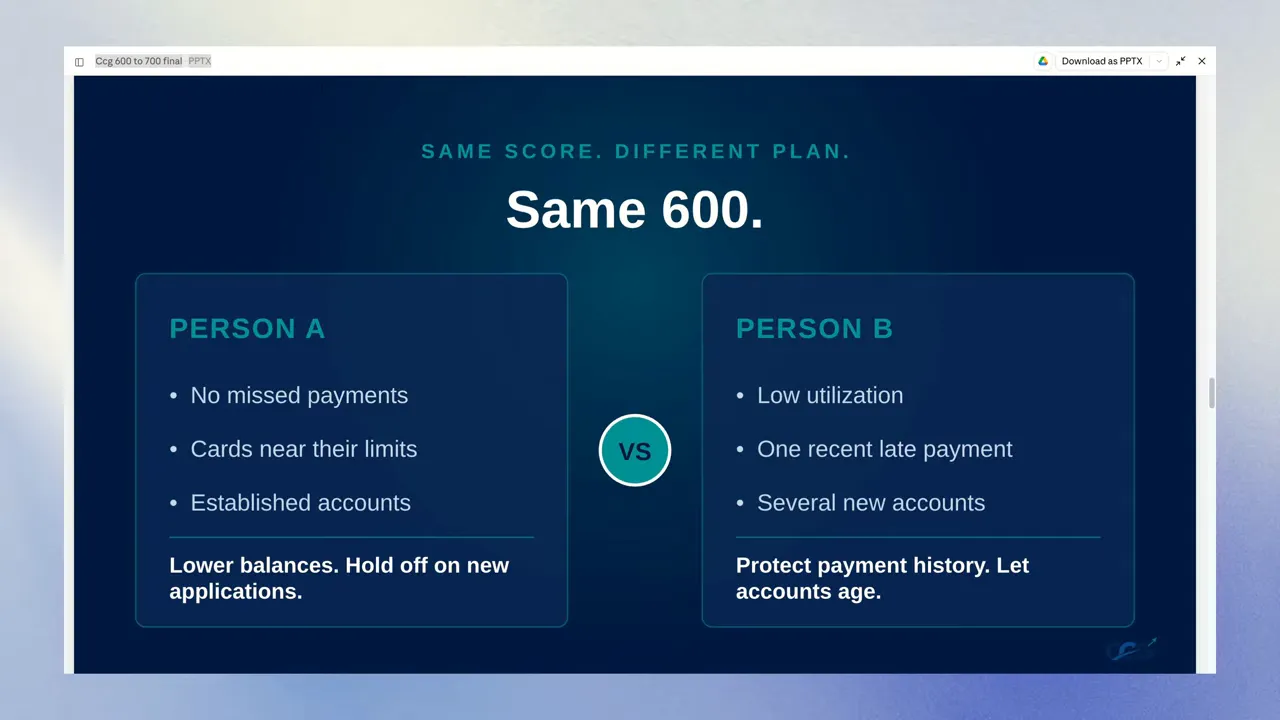
The same starting score can call for two very different priorities.
Same starting score. Same general goal. Completely different plan. That’s why I keep coming back to profile first, points second.
How long does it take to go from 600 to 700?
There’s no honest universal answer. If high revolving balances are the biggest issue and they come down substantially, you may see meaningful changes after the new balances are reported. If the main issue is recent late payments, serious negative information, or a very thin file, improvement can take much longer.
Be skeptical of anyone guaranteeing 100 points in 30, 60, or 90 days. I also wouldn’t expect one secured card or one new account to magically add 100 or 200 points. Build the stronger profile first, then allow time for the changes to show up.
Research your next application when you’re ready
I wouldn’t begin this process by shopping for another card. I’d review the reports, find the biggest weaknesses, fix what I can control, and stop adding new problems. Once the profile is stronger and a new application makes sense, product research comes back into the picture.
That’s the purpose of the AI Credit Card Showdown: we test recommendations from six AI systems, then verify and score what we find against actual card information and terms. It isn’t a promise of approval. It’s better information for making your own decision.
Before submitting an application, work through the free 10-point Credit Application Readiness Checklist. It’s meant to help you think through that decision before you apply.
Check Your Readiness Before You Apply
Use the free 10-point Credit Application Readiness Checklist to work through your next credit application decision.
Build the profile and let the score follow
Don’t carry interest-bearing debt to build credit. Don’t dispute accurate information just because it’s negative. Don’t open a pile of accounts hoping for automatic points, and don’t let daily score fluctuations distract you from real progress.
Start with your reports. Protect your payments. Bring down high reported balances when you can, and let positive history grow. The score should follow the information, not the other way around.
This article is for educational purposes and is not individualized financial advice. Credit offers and eligibility can change. Verify current terms with the issuer before applying; approval is not guaranteed.
Want to see how cards stack up? Explore the AI Showdown
Related Content
Credit Application Readiness Checklist
Get instant access to our free Credit Application Readiness Checklist. No spam — just the steps you need before you apply for any credit card.